When every brand reacts to the same moment, who is actually being creative?
As brands rush to react to the same cultural moments, industry experts warn that the format that makes one response sharp can turn the next ten into template work, putting distinctiveness at risk
 by
by
Published: Aug 28, 2026 8:29 AM | 8 min read
 Follow Us

- Instagram has updated its wordmark for the first time in a decade, leading various brands to creatively adapt their names to the new style, sparking discussions about the nature of reactive advertising versus creative imitation.
- The pressure for brands to respond quickly to cultural moments has intensified, with digital advertising in India reaching ₹45,292 crore in 2024, highlighting the importance of speed in brand communication.
- Industry experts argue that reactive advertising often lacks depth and originality, as many brands produce similar content that could apply to multiple logos, diminishing their distinctiveness in the marketplace.
- The consensus among strategists is that preparation and a clear brand perspective are crucial for meaningful engagement, suggesting that brands should focus on insightful responses rather than merely reacting to trends.
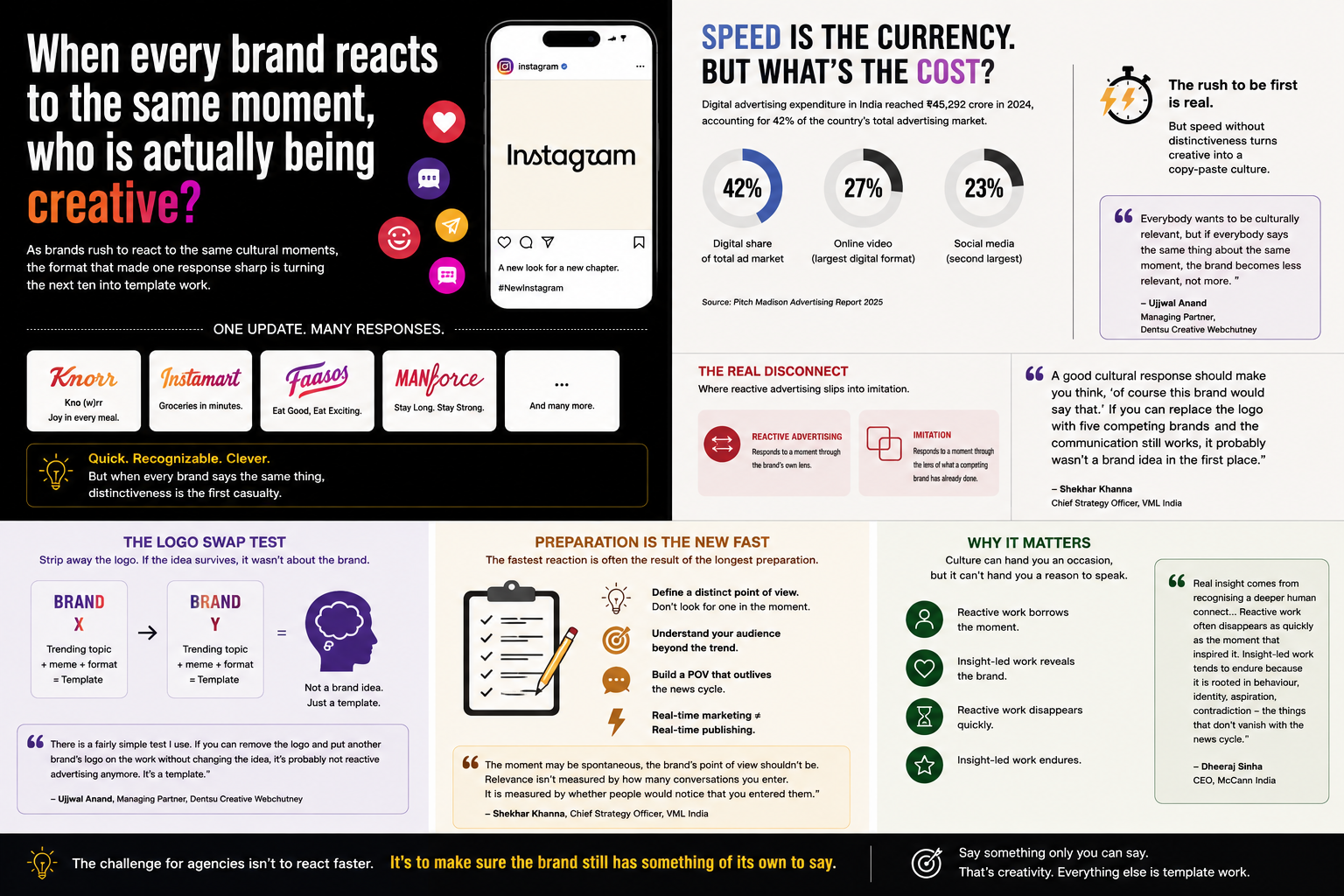
Instagram changed its wordmark for the first time in 10 years, prompting brands to put their own spin on the refresh. Knorr, Instamart, Faasos, Manforce and others recreated their names in Instagram’s new visual style, turning a platform update into a ready-made moment for brands to jump on. It was quick, recognizable, and, for a few minutes, clever. But when the same cultural moment produces a parade of near-identical brand responses, a bigger question emerges: where does reactive advertising end and creative imitation begin?
That question goes well beyond a redesigned wordmark. From World Cup nights and viral controversies to celebrity moments and memes, brands are increasingly expected to have an opinion within minutes of something becoming culturally relevant. Speed has become part of the creative currency. But when everyone is racing to be first into the conversation, the work can start looking less like a distinctive brand response and more like a template with different logos. The challenge for agencies, then, is no longer simply to react faster. It is to make sure that, amid the rush to say something, the brand still has something of its own to say.
Read On: Instagram changes wordmark for first time in a decade, app icon stays
The speed premium and its shadow cost
The pressure driving this behaviour is not imagined. Digital advertising expenditure in India reached ₹45,292 crore in 2024, accounting for 42% of the country’s total advertising market, according to the Pitch Madison Advertising Report 2025. Online video was the largest digital format at 27% of spend, followed by social media at 23%. As more brand communication moves into fast-moving digital environments, the pressure to respond to cultural moments in real time has grown alongside it.
The question is whether that speed is leaving enough room for brands to say something that is distinctly their own.
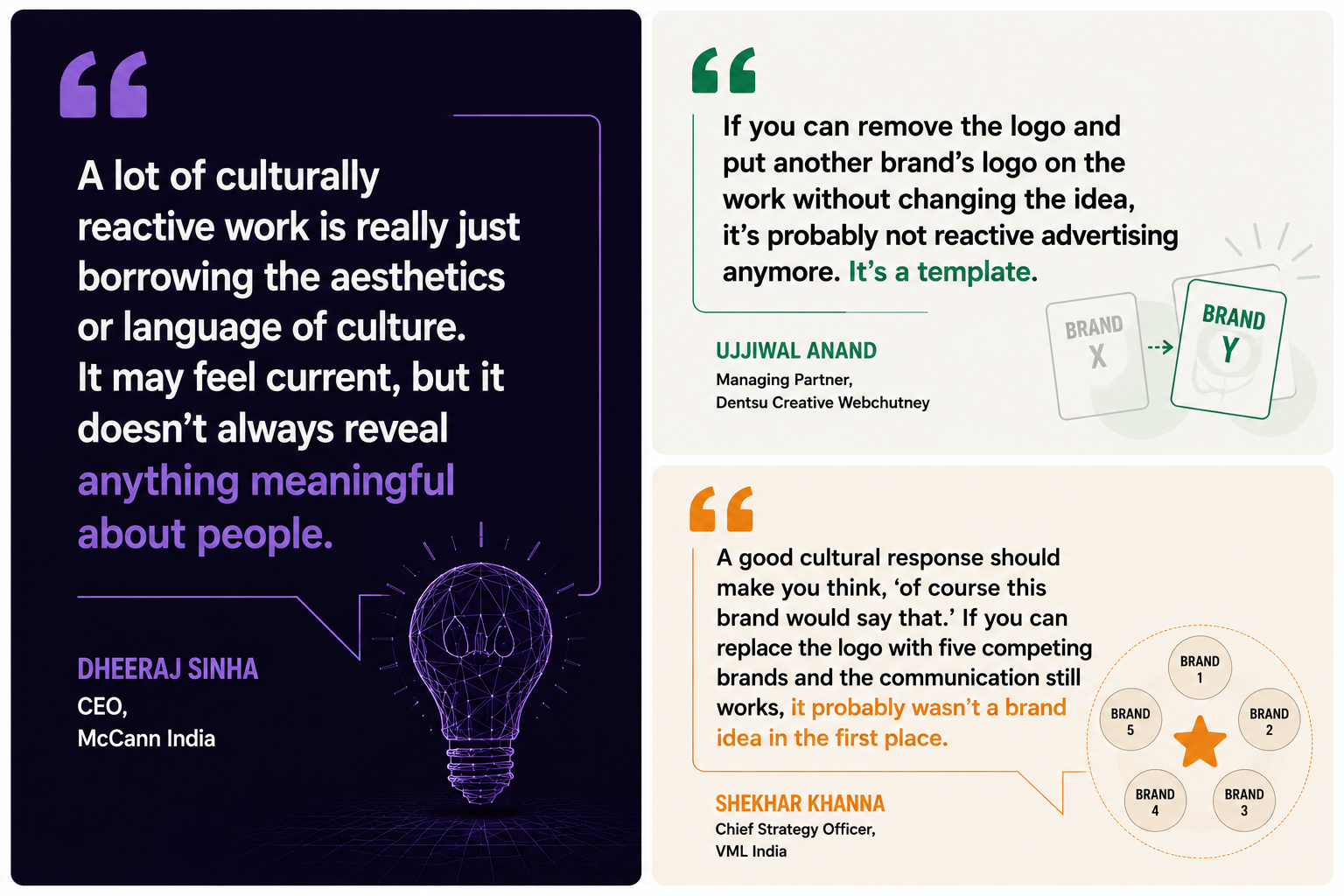
Dheeraj Sinha, CEO of McCann India, argues that the problem sits deeper than execution speed. “A lot of culturally reactive work is really just borrowing the aesthetics or language of culture,” he says. “It may feel current, but it doesn’t always reveal anything meaningful about people. It has topical relevance, but not necessarily emotional depth.”
For Sinha, the distinction between reactive work and insight-led work is not cosmetic; it is structural. Reactive advertising borrows the surface texture of a moment: its slang, its visuals, its momentary intensity. Insight, on the other hand, is built on something that predates the moment and will comfortably outlast it too.
“Real insight comes from recognising a deeper human connect, something people instinctively relate to, even if they’ve never articulated it themselves,” Sinha explains. “Reactive work often disappears as quickly as the moment that inspired it. Insight-led work tends to endure because it is rooted in behaviour, identity, aspiration, contradiction - the things that don’t vanish with the news cycle.”
Read On: Why brands are learning that not every cultural moment needs a response
The logo swap test
The clearest symptom of reactive advertising turning into a formula is when the creative work becomes brand-agnostic. Strip away the logo, and if nothing about the joke, the reference, or the visual language changes, the idea was probably never about the brand to begin with; it was only ever about the moment.
Ujjwal Anand, Managing Partner at Dentsu Creative Webchutney, applies exactly this test to reactive work. “There is a fairly simple test I use,” he says. “If you can remove the logo and put another brand’s logo on the work without changing the idea, it’s probably not reactive advertising anymore. It’s a template.”
For Anand, culture should only ever supply the occasion, never the idea itself; the brand still has to bring something to the work that could not have come from anywhere else. Take the cultural moment away, in his framing, and the work may well disappear, but take the brand away and the idea should become impossible to make in the first place.
That same instinct, arrived at independently, runs through Shekhar Khanna’s reading of the problem. As Chief Strategy Officer at VML India, Khanna draws a similar line between response and imitation; only he frames it through voice rather than mechanics. Reactive advertising, in his view, responds to a moment through the brand’s own lens. Imitation responds to a moment through the lens of what a competing brand has already done with it.
“A good cultural response should make you think, ‘of course this brand would say that,’” Khanna says. “If you can replace the logo with five competing brands and the communication still works, it probably wasn’t a brand idea in the first place.”
Read On: Is creative excellence losing its currency?
When everyone speaks, relevance gets quieter
There is an irony sitting at the centre of this entire debate. The scramble to be culturally relevant is, paradoxically, making brands less distinct. When every account posts a version of the same joke within the same news cycle, the collective effect cancels itself out, and audiences stop crediting any single brand with having said something worth remembering.
“Everybody wants to be culturally relevant, but if everybody says the same thing about the same moment, the brand becomes less relevant, not more,” Anand says. The problem, in his assessment, is not that brands are becoming too reactive; it is that some brands are becoming reactively unoriginal.
Anand points to research from a global creative effectiveness firm which found a sizeable share of marketers were testing very little of their creative work, with cost and speed cited among the reasons, alongside separate industry analysis linking short-term, executionally driven marketing to declining creative effectiveness across several hundred documented case studies.
Neither data set is India-specific, and the figures have not been independently verified for this piece, but the direction they point to lines up with what strategists on the ground are describing: compressed timelines leave less room for testing, and less testing leaves more room for the safest, most imitative idea to win the brief.
Khanna traces this compression to the always-on nature of social platforms. “Social media has created an almost artificial pressure for brands to have an opinion on everything,” he says. “A moment happens at 8 PM, and by 8:15 PM everyone is asking, ‘what are we doing on this?’ That inevitably pushes agencies towards the first available joke, meme, or format rather than the most interesting idea.”
Read On: From production houses to prompt rooms: AI rewrites the agency workflow
Preparation is the new fast
If speed is not the villain, slowing down cannot be the fix either. What both strategists arrive at, from different directions, is a case for preparation over caution: agencies and brands that have already done the work of defining a distinct point of view do not need extra time to find one when a cultural moment breaks.
“The fastest reaction is often the result of the longest preparation,” Anand says. He draws a line many in the industry have started repeating: real-time marketing is not the same as real-time publishing. A brand can spend three hours producing a post and still say nothing worth reading, just as it can spend ten minutes landing on an idea people remember for years.
That distinction, between publishing fast and thinking clearly, is where Anand believes the real test of reactive work lies: a trend is what everyone is already talking about; an idea is what the brand specifically has to add to it. If the honest answer to why a brand jumped on a moment is simply that it could move quickly, the work, in his assessment, was never finished in the first place.
Khanna reaches a similar conclusion from the brand-building side of the argument. “The moment may be spontaneous, the brand’s point of view shouldn’t be,” he says. “Relevance isn’t measured by how many conversations you enter. It is measured by whether people would notice that you entered them.”
Put together, the counsel coming out of these three agency heads points in the same direction even though none of them frame it identically. Sinha’s case for insight over topicality, Anand’s logo test, and Khanna’s argument for a defined worldview are really three versions of the same warning: that culture can hand a brand an occasion, but it cannot hand it a reason to speak. The agencies that keep finding something worth saying, long after the moment that triggered the response has scrolled past, are the ones that had done the thinking long before the notification came in.
Read more news about Internet Advertising India, Marketing News, PR and Corporate Communication News, Digital Media News, Television Media News
For more updates, be socially connected with us onInstagram, LinkedIn, Twitter, Facebook YouTube & Google News